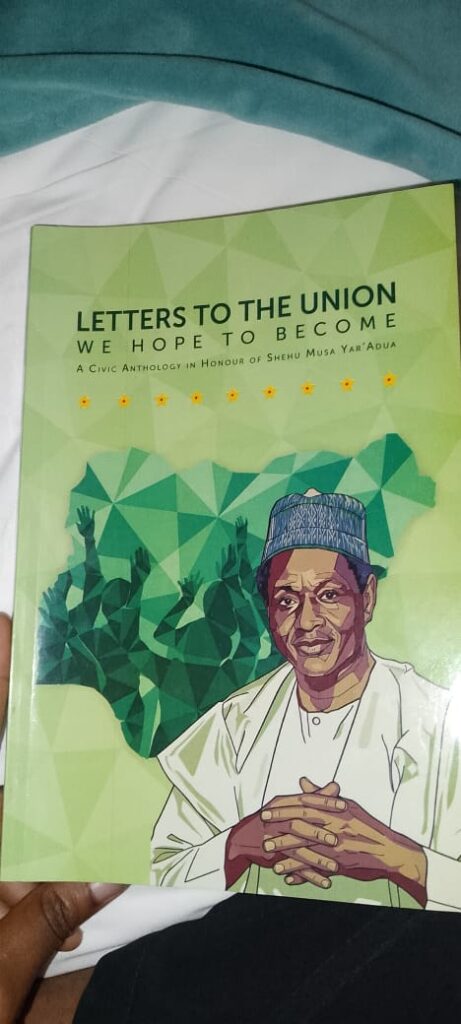

December 8 was not just another date on Nigeria’s calendar. It marked the 28th anniversary of the death of one of the nation’s most principled figures, Shehu Musa Yar’Adua, and it became a moment of collective memory, reflection, and renewed civic responsibility with the launch of Letters to the Union We Hope to Become, a civic anthology in honour of late Shehu Musa Yar’ Adua.
READ ALSO: Mother of Late President Yar’adua dies at 102
The event opened solemnly but warmly with a welcome address by Vivian Emehule, Director of Programmes and Administration at the Shehu Musa Yar’Adua Foundation. In her calm but purposeful tone, she welcomed dignitaries and guests, setting the atmosphere for a day that would blend remembrance with hope. A tribute prayer followed, grounding the gathering in reverence for a man whose life continues to echo in Nigeria’s civic conscience.
Atiku Abubakar, former Vice President of Nigeria and Chairman of the Board of Directors of the Shehu Musa Yar’Adua Foundation, delivered the first special remarks. Reading from a heartfelt letter, he paid tribute to the late Yar’Adua, describing the occasion as a moment to “receive his legacy.” His words moved beyond nostalgia, offering prayers for Nigeria and reminding the audience that legacy is not only inherited but also sustained through values, service, and responsibility.
The host returned to the stage to reflect on the warmth of the letter, describing it as one written not just to the past, but to unborn generations, future selves, and the Nigerian nation itself. She then welcomed the Secretary to the Government of the Federation, Senator George Akume, who represented President Bola Ahmed Tinubu, Commander-in-Chief of the Armed Forces of the Federal Republic of Nigeria.
Speaking on behalf of the President, Akume acknowledged the President’s absence due to official engagements and conveyed his goodwill. He described Shehu Musa Yar’Adua as a soldier who placed Nigeria above self, a political strategist whose life embodied integrity, sacrifice, and service. He noted that the anthology was not merely a book, but a call to responsibility urging transparency in governance, trust between government and citizens, youth empowerment, social justice, and leadership rooted in integrity. In his words, “Every Nigerian has the right to write the next story.” The speech concluded with a salute to the Yar’Adua family and a renewed call to national unity.
The symbolic unveiling of the anthology followed, as dignitaries in the front row including the representative of the president and Atiku Abubakar stood together to present Letters to the Union We Hope to Become to the public. Each held up the book, a quiet but powerful reminder that Nigeria’s future can still be shaped by words, ideas, and shared values.
One of the most emotional moments of the event came during an interview with Buhari Yar’Adua, son of the late Shehu Musa Yar’Adua. As a letter written to him by his father on September 12, 1996, was read aloud, the hall fell into reflective silence. He recalled receiving the shocking news of his father’s arrest and death sentence from a taxi driver while heading to school. The pain was so overwhelming that he could not visit his father for a year. When he eventually did, he said simply, “I was happy to see him, even though his face wasn’t as full as I always knew it to be.” He spoke of learning about his father’s character, his humility, responsibility, and patriotism mostly from co-workers, as Yar’Adua had been deeply private about his work. For him, patriotism meant looking inward, appreciating who Nigerians are, and understanding that both the problems and solutions of Nigeria lie within the country.
The programme then turned to readings from the anthology. Zainab Illiassu read a deeply moving letter addressed to her young son, Abdullah. As she described him sleeping peacefully in the next room, she reflected on the Nigeria he would inherit a nation of contradictions, brilliance and frustration, pain and promise. She spoke of a future where technology advances rapidly, but values like kindness, integrity, courage, and compassion must remain timeless. Being Nigerian, she said, is not a choice of birth, but a daily choice to contribute to something greater. Her letter ended with a promise to build a better Nigeria than the one she inherited.
The second reader, Mrs. Didi Esther Walson jack. Head of the civil service of the federation, addressed her letter to Nigeria itself. She spoke of watching the nation mature, hoping for change through steady reforms, ethical leadership, and civil service integrity. Her message was simple but profound: “Choose to build, not blame.”
Art then took centre stage as poet Dike chukwumerije led a spoken-word performance that blended poetry, drama, and music. Through flashbacks to moments of shared national pride such as Nigeria’s comeback victory against Brazil at the 1996 Atlanta Olympics the performance reminded the audience of a time when patriotism transcended ethnicity and language. A dramatic play unfolded, portraying bribery, political manipulation, cynicism, youth apathy, and ethnic division. Characters symbolized Nigeria’s realities: the corrupt politician, the hopeless critic, the distracted youth, and the resilient patriot who refused to give up on the nation.
As tensions escalated, ethnic divisions were deliberately stirred on stage, mirroring real-life political tactics. Yet hope returned when the youth character, initially indifferent and eager to leave Nigeria, was persuaded that technology, civic engagement, and collective action could still reshape the nation. The performance ended in unity dance, song, and a final poetic call for a Nigeria free of corruption, tribalism, and injustice, where every vote counts and every child feels safe to dream.
In her closing remarks, Vivian Emehule thanked attendees and reflected on the power of the letters compiled in the anthology. She described them as visions, prayers, and testimonies from Nigerians writing to their unborn children, future selves, institutions, and the nation itself. Quoting one contributor, she reminded the audience that Nigerians are “threads of one fabric,” bound by shared struggles and hopes, and that with love, sacrifice, and belief, the union Nigeria hopes to become will indeed rise.
As the event came to a close, one truth lingered in the air: Nigeria’s story is still being written and these letters are an invitation to write it better.
Written by
Igboka Annabel Chinenye
Department of Development and Strategic Communication,
University of Abuja